ATPR Africa | Publication
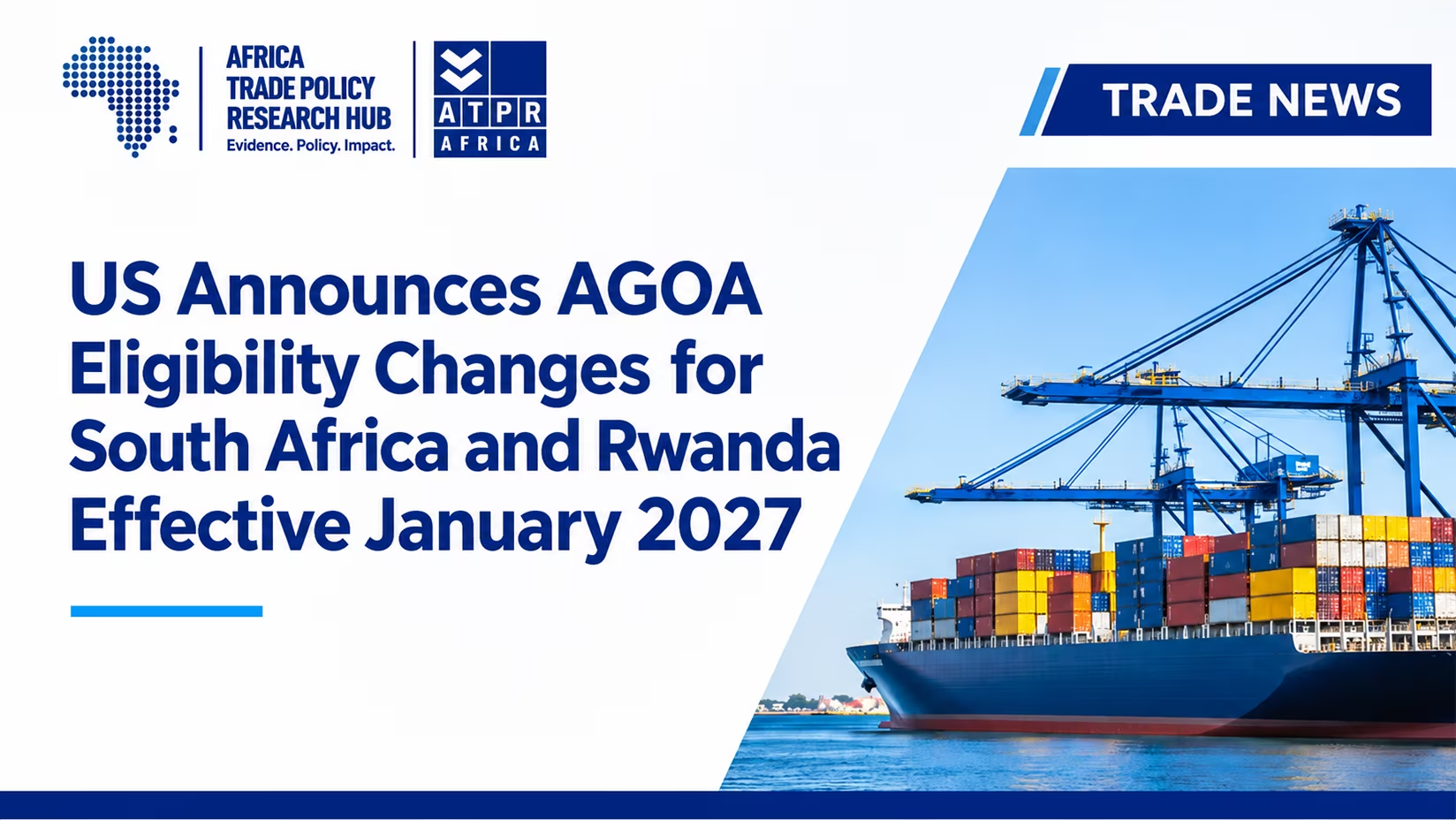
US Announces AGOA Eligibility Changes for South Africa and Rwanda Effective January 2027
ATPR AFRICA | TRADE NEWS | US–AFRICA TRADE
5 November 2026
The United States has announced plans to terminate South Africa and Rwanda’s eligibility under the African Growth and Opportunity Act (AGOA), effective 1 January 2027. The decision follows an annual review of participating countries and highlights the importance of eligibility requirements, market access and continued economic engagement between the United States and African economies.
The United States has announced its intention to terminate South Africa and Rwanda’s preferential trade benefits under the African Growth and Opportunity Act (AGOA), following a review of whether both countries continue to meet the programme’s eligibility requirements.
On 2 November 2026, US Trade Representative Jamieson Greer announced that President Donald Trump had notified Congress and the governments of South Africa and Rwanda of his intention to terminate their AGOA eligibility, effective 1 January 2027.
The announcement followed the annual eligibility review conducted by the Office of the United States Trade Representative (USTR). The review examined whether participating countries continued to meet the economic, governance and policy requirements established under AGOA.
Introduced in 2000, AGOA provides eligible sub-Saharan African countries with duty-free access to the US market for thousands of qualifying products. The programme has supported African exports, encouraged investment and strengthened commercial relations between the United States and participating economies.
The latest announcement demonstrates that extending AGOA does not automatically guarantee continued eligibility for every participating country.
Why the United States is reviewing eligibility
The US administration has announced its intention to terminate South Africa and Rwanda’s eligibility under AGOA following an annual review of participating countries.
According to the official statement issued by the Office of the United States Trade Representative (USTR) on 2 November 2026, the Trump administration identified several concerns relating to the two countries’ compliance with AGOA eligibility requirements.
For Rwanda, the administration expressed deep concern about trade and investment barriers, the rule of law, political pluralism, internationally recognised workers’ rights, human rights, and threats to US national security and foreign policy interests.
For South Africa, the administration expressed deep concern about barriers to US trade and investment, corruption, and threats to US national security and foreign policy interests.
US Trade Representative Jamieson Greer also emphasised the administration’s intention to ensure that African trading partners take the necessary steps to meet AGOA’s eligibility requirements.
Implications for trade and investment
The proposed changes may have implications for exporters in South Africa and Rwanda, particularly businesses that have relied on preferential access to the US market.
South Africa has been among the major African beneficiaries of AGOA, with exports covering automotive products, agricultural commodities and manufactured goods.
The withdrawal of preferential treatment could increase applicable import duties on qualifying products, potentially affecting export costs and competitiveness.
For Rwanda, the development may influence export planning and investment decisions in sectors seeking access to the American market.
However, the proposed termination of AGOA eligibility does not prohibit either country from trading with the United States. Businesses may continue exporting to the American market under applicable tariff schedules and import regulations.
The development therefore places greater emphasis on trade policy engagement, regulatory compliance and the ability of exporters to remain competitive under changing market conditions.
AGOA and US–Africa economic relations
AGOA has been an important part of US economic and commercial engagement with sub-Saharan Africa since its introduction in 2000.
The programme provides eligible African countries with duty-free access to the American market for qualifying products. It has created opportunities for exporters, investors and businesses seeking to strengthen commercial relationships between the United States and African economies.
According to the USTR’s official AGOA programme overview, participating countries must establish, or make continual progress towards establishing, market-based economies, the rule of law, political pluralism and due process.
The programme also requires progress in eliminating barriers to US trade and investment, reducing poverty, combating corruption and protecting human rights.
These requirements demonstrate that AGOA combines preferential market access with broader economic and governance eligibility conditions.
AGOA extension to 2028 and continued eligibility
The announcement comes after the extension of AGOA through 31 December 2028, allowing eligible countries to continue benefiting from the programme during the extended period.
The US Department of Commerce’s official AGOA legislative history identifies the legislation extending the programme, including Division B, Section 2008 of the Continuing Appropriations and Extensions Act, 2027 (Public Law 119-103).
The extension provides a continuing framework for preferential trade between the United States and eligible sub-Saharan African economies.
Nevertheless, the continuation of the programme does not remove the conditions governing individual country eligibility.
Under AGOA’s legal framework, the United States retains authority to review eligibility and determine whether participating countries continue to satisfy the established requirements.
This distinction matters for businesses making long-term investment decisions. Exporters and investors need to consider both the duration of a trade preference programme and the conditions governing access to its benefits.
Strengthening US–Africa trade cooperation
AGOA continues to provide an important framework for strengthening commercial relations between the United States and eligible African economies.
Its value extends beyond tariff preferences. Access to the American market can encourage investment, support export-oriented production and create opportunities for businesses to develop international commercial partnerships.
For African governments, maintaining these opportunities requires continued attention to the policy and regulatory conditions governing trade preferences.
Constructive engagement with the United States can help governments understand eligibility concerns, communicate policy reforms and identify opportunities for stronger economic cooperation.
At the same time, African economies can strengthen their competitiveness by improving production capacity, reducing trade costs and supporting businesses in meeting international standards.
These reforms can help exporters benefit more effectively from existing trade arrangements while improving their ability to compete in other international markets.
Priorities for African governments
The latest AGOA development points to three priorities for African countries seeking to maintain and expand trade relations with the United States.
First, strengthen policy engagement. Governments should maintain regular dialogue with US trade authorities to understand eligibility requirements and address concerns that could affect continued participation in AGOA.
Second, improve trade and regulatory compliance. African countries should support reforms that reduce unnecessary trade barriers, improve transparency, strengthen the business environment and help exporters meet international requirements.
Third, expand export competitiveness. Governments should encourage investment in manufacturing, agricultural processing and other productive sectors capable of supplying regional and international markets.
The African Continental Free Trade Area (AfCFTA) can complement these efforts by helping African businesses develop regional supply chains and expand their production capacity.
Regional economic integration and stronger trade relations with the United States can reinforce one another. Both can contribute to more diversified and competitive African economies.
Looking ahead
The proposed termination of South Africa and Rwanda’s AGOA eligibility represents an important development in the administration of US trade preferences.
The decision illustrates the distinction between extending a preferential trade programme and maintaining the eligibility of individual participating countries.
It also reinforces the importance of understanding the policy objectives and legal requirements that underpin access to the American market.
For African governments, the priority should be to maintain constructive economic engagement with the United States while strengthening domestic reforms that support investment, export growth and international competitiveness.
AGOA remains a valuable instrument for US–Africa economic cooperation. Its long-term contribution will depend on continued policy engagement, compliance with eligibility requirements and stronger commercial partnerships that benefit businesses and economies on both sides.
References and official sources
-
Office of the United States Trade Representative (2 November 2026).
Ambassador Greer Issues Statement on President Trump’s Intent to Terminate Rwanda and South Africa from the AGOA Trade Preference Program.
-
Office of the United States Trade Representative.
African Growth and Opportunity Act (AGOA): Programme Overview and Eligibility Requirements.
-
US Department of Commerce, International Trade Administration.
AGOA Trade Preference: Programme Provisions and Legislative History.
Editorial note: This article reports the US administration’s stated reasons for the proposed AGOA eligibility changes. The discussion of trade implications and policy recommendations represents ATPR Africa’s independent analysis.
About ATPR Africa
The Africa Trade Policy Research Hub (ATPR Africa) is an independent, non-partisan pan-African research institution focused on international trade policy, regional economic integration, trade facilitation and sustainable economic development.