ATPR Africa | Policy & Business Article
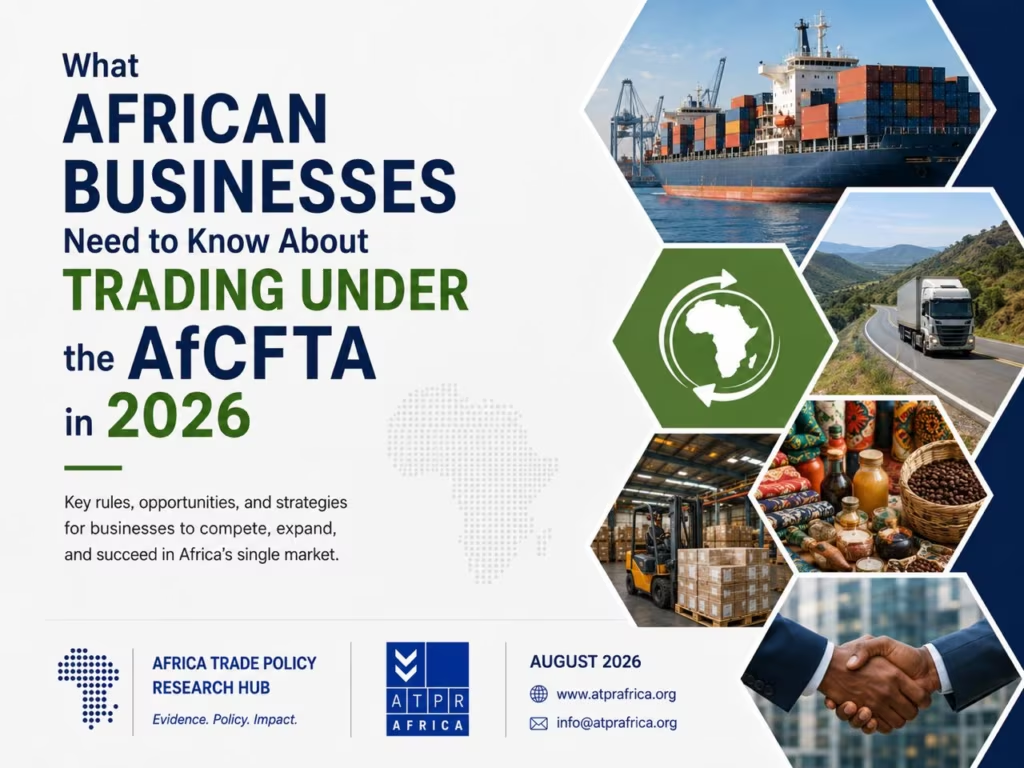
What African Businesses Need to Know About Trading Under the AfCFTA in 2026
A practical guide to preferences, origin, customs, non-tariff barriers, payments and cross-border readiness.
The AfCFTA offers African businesses the possibility of reaching customers across a much larger continental market under progressively more favourable trade conditions. But the agreement does not mean that every shipment between African countries automatically receives a lower tariff.
For a business, using the AfCFTA is a compliance process as much as a market opportunity. The exporter needs to know whether the destination market is trading under the relevant AfCFTA arrangements, identify the tariff treatment for the product, satisfy the applicable rule of origin, prepare the required documentation and comply with customs, standards and other regulatory requirements.
The practical question for firms in 2026 is therefore not simply: ‘Is my country part of the AfCFTA?’ It is: ‘Can this particular product, moving from this country to this destination, qualify for and successfully use the AfCFTA preference?’
1. Start with the product, not the agreement
A business should begin by identifying the correct customs classification of the product. The Harmonized System code is important because tariff treatment and product-specific origin requirements are linked to classification.
An incorrect classification can lead to the wrong tariff assumption, the wrong origin test or delays at customs. Firms should therefore build product classification into their export-readiness process rather than waiting until the shipment reaches the border.
2. Check whether an AfCFTA preference is actually available
The existence of the AfCFTA does not by itself establish the tariff payable on every transaction. Businesses need to check the applicable tariff schedule and trading arrangement for the exporting and importing countries and the product concerned.
The commercial comparison should be straightforward: what tariff would apply under the AfCFTA, what tariff would otherwise apply, and is the preference large enough to justify the compliance steps required to claim it?
3. Rules of origin determine whether the product qualifies
Preferential tariffs are intended for products that meet the AfCFTA’s origin requirements. Businesses therefore need to determine whether their goods are wholly obtained or sufficiently produced or transformed within participating AfCFTA economies under the applicable product-specific rule.
This is particularly important for manufacturers that use imported inputs. Firms should understand the origin status of materials, maintain supplier records and preserve production information capable of supporting an origin claim.
- 01Classify Product
- 02Check Preference
- 03Test Origin
- 04Prepare Documents
- 05Clear & Settle
4. Documentation is part of the market-access strategy
A qualifying product still needs evidence. AfCFTA trade guidance identifies proof of origin, together with normal commercial and customs documentation, as part of the process for claiming preferential treatment.
Businesses should establish an internal file for each export product containing classification records, supplier declarations where relevant, production information, invoices, transport documents and origin documentation. Good recordkeeping reduces the risk of a preference being denied during verification.
5. Preferential tariffs do not remove other border requirements
An AfCFTA tariff preference does not eliminate sanitary and phytosanitary measures, technical regulations, product standards, labelling rules, import permits or sector-specific requirements that may lawfully apply in the destination market.
Before entering a new market, a firm should therefore complete a regulatory check covering both tariff and non-tariff requirements. This is particularly important for food, agricultural products, pharmaceuticals, cosmetics, chemicals and regulated manufactured goods.
6. Know what to do when a non-tariff barrier appears
Cross-border traders may encounter delays, duplicative procedures, administrative restrictions or other obstacles that are not tariffs. Businesses should document the problem carefully: border location, agency involved, date, requirement imposed, costs, supporting correspondence and the commercial impact.
A well-documented barrier is easier to escalate through national authorities, business associations or relevant AfCFTA non-tariff-barrier channels than a general complaint without evidence.
7. Payments, logistics and finance can determine whether the sale is viable
Market access is only one part of a cross-border transaction. Businesses must also decide how they will be paid, manage currency and settlement risk, finance working capital, insure the shipment and select a logistics route.
The AfCFTA implementation ecosystem increasingly recognises these practical constraints. AfCFTA programming has highlighted digital payments for MSMEs, SME digital trade, e-commerce and trade and investment facilitation as areas that matter for cross-border participation.
A seven-point AfCFTA business readiness check
Product classification
Confirm the HS code and product description used for customs.
Tariff treatment
Verify the applicable AfCFTA preference for the product and destination.
Origin eligibility
Test the product against the relevant rule of origin before shipping.
Evidence
Maintain the records needed to support the origin claim and customs declaration.
Regulatory compliance
Check standards, permits, labelling and sector-specific requirements.
Transaction infrastructure
Plan payment, finance, insurance, transport and border handling.
Post-entry learning
Track delays, rejected documents, costs and barriers and improve the next shipment.
What SMEs should do differently
For SMEs, the most effective approach is to start narrow. Choose one or two target markets and a limited number of products. Build a repeatable compliance file, identify a customs or logistics partner familiar with the route, understand the origin rule before quoting the customer and calculate the full landed cost rather than focusing only on the preferential tariff.
Digital tools can reduce some of the information and transaction burden, but businesses should avoid assuming that a digital marketplace alone solves customs, origin, standards, payments or logistics requirements.
The bigger commercial opportunity
The AfCFTA can do more than reduce the tariff on a finished export. It can change how African firms organise sourcing and production. As rules of origin, cumulation, customs cooperation and regional infrastructure become more usable, businesses can increasingly consider suppliers and production partners across African markets.
That is where the deeper commercial opportunity lies: not simply selling the same product into more countries, but building African supply chains capable of serving a continental market.